Thursday, March 24, 2011

Veterans of USFL and CFL - cite grind and danger of an 18-game season

Doug Flutie remembers feeling how his arm was ready to fall off during his one year in the USFL. Nate Newton recalls how he did absolutely nothing but rest for an entire month after playing his two USFL 18-game regular seasons.
And former CFL quarterback Danny McManus can still see the telltale signs of blurry-eyed fatigue that set in on rookies when Week 13 rolled around in Canada with five games still left to play.
For those wondering what the effects might be if the NFL expands from 16 to 18 regular-season games, take it from those who've been through it: It's a grind.
"From week to week, game plan to game plan, there's the physical part, but the mental part of the preparation is what wears a guy down," said Newton, a former star offensive lineman, who began his pro career in 1984 with the USFL Tampa Bay Bandits. "You're going to blow a fuse. It's just bound to happen."
Newton got a taste of playing an 18-game season before going on to become a six-time Pro Bowl selection with the Dallas Cowboys.
McManus, who played for Florida State, spent 17 seasons in the CFL where 18-game schedules have been the norm since 1986.
"You'd see it around Week 13 through Week 16, these guys are just dragging themselves into the locker room," said McManus, who retired in 2006 and is now the head U.S. scout for the Hamilton Tiger-Cats. "There's no doubt it's a grind to go 18 weeks. And we used to do it going 18 weeks straight."
Of course, that led to some unorthodox recuperating methods.
"The saying we have up in Canada is we ice from the inside out," McManus said, laughing. "And that's because of a lot of that Canadian beer up there. That's the quickest way to get into the muscles, to ice from the inside out."
These are among the sobering messages from several ex-USFLers and CFLers -- rounded out by Hall of Famer Jim Kelly, who broke in with the USFL's Houston Gamblers in 1984 before starring for the Buffalo Bills -- with firsthand knowledge of playing 18-game seasons.
All agreed the expanded schedules required a big adjustment from players.
And Kelly even wondered whether the NFL is using the 18-game schedule as a ploy in labor talks, which are now on hold after breaking down two weeks ago.
"It's almost like they're holding it over the players so they at least have something to give back," Kelly said. "This is my personal opinion."
Ploy or not, the NFL went into negotiations with a desire to expand its regular season for the first time since going from 14 to 16 games in 1978.
In going to 18 games, the NFL would eliminate two preseason games in exchange for adding two regular-season games with the prospect of generating more revenue.
NFL players have balked at the proposal.
They've complained that an expanded schedule would increase the risk of injuries and, as a result, have the potential of shortening careers, thus cutting into their money-earning potential and reducing their retirement benefits.
Players have also fear how much two more games would cut into their offseasons, which are already filled with mandatory and voluntary minicamps and workout programs from March to June.
The NFL did back off on its proposal in its last offer before talks broke down. The NFL proposed maintaining the 16 regular-season games and four preseason games for at least two years, with any switch to 18 games being negotiable.
Injuries, fatigue and weather conditions -- imagine how many fans would show up to a Week 19 mean-nothing game in January in wintry Buffalo, Kelly wondered -- were among concerns expressed by the each of 18-game veterans.
For Newton, an 18-game NFL schedule would require the league to expand its rosters from 53 to at least 60 players. And teams would be keen in stocking their lineup with at least two capable running backs and two quarterbacks to guard against injuries.
Flutie didn't even complete his one USFL season with the New Jersey Generals. His year ended 15 games in when he broke his collarbone after being sacked by Reggie White. Then again, Flutie's throwing arm was already feeling shot by then.
"I thought I was fine and I was gung-ho," Flutie said, of how he initially felt reporting for training camp. "And then, about four weeks into it, my arm felt dead and there was no break coming. ... You felt like the season should be over, and you're just at the midpoint."
The USFL experience made it easier for Flutie to adjust to the CFL, where he spent eight seasons. And it helped that training camps in Canada last three weeks, and teams only play two preseason games.
"And that's part of the problem in the NFL is they've got them all spring working out," Flutie said. "Then, you go through a long grueling training camp and the preseason games and then try to go 18 games. That's what I think would make it ridiculously difficult."
For McManus, the key in the CFL was players and coaches pacing themselves.
With so little time for preparation, McManus said teams approached the first two regular-season games with a preseason mentality in determining starters and developing game plans.
The CFL game is different from the NFL, and better suited to speedier players. The three-down league has 12-man lineups playing on wider and longer fields, that feature 20-yard end zones.
What's not different, as McManus noted: "Hitting is still hitting"
"Those guys in the trenches, to do that much hitting, you're going to start seeing some more shoulder injuries, head injuries," he said, noting injuries also occur when players get fatigued.
"We get that quite a bit," McManus said. "Guys aren't sure how to run a route or are just jogging through it and someone else on the other side is not jogging through it. That's where we get some of the injuries." 

Reported By: Associated Press


Wednesday, March 23, 2011

Peyton Hillis Has Legitimate Chance To Win Madden 2012 Cover

Peyton Hillis has solidified himself as a hero in the eyes of Cleveland Browns fans in just one short season on the shores of Lake Erie. Hillis steamrolled defenders and even found a way to leap over many would-be tacklers on his way to one of the best statistical rushing seasons for any Browns player since reinstatement in 1999. If all of the attention surrounding Hillis’ play on the field wasn’t enough, now he has a great chance to become the next cover man of the infamous Madden football video game.

Vote for Peyton Hillis HERE

This is the first year that EA Sports is allowing NFL fans to vote for their favorite players and have a bracket-like format in order to decide who will be on the cover of one of the best annual sports games in history.
Ray Rice of the Baltimore Ravens will be the player against Hillis in the first round of voting as the format of the tournament seeds players from 1-16 on two sides. Rice and Hillis were both listed at 7 and 10 respectively.
The winner of that matchup will then go on to face the winner between Matt Ryan of the Atlanta Falcons and Jordan Gross of the Carolina Panthers.
The Cleveland Browns have one of the biggest fan bases in the world as the teams’ official fan society, the Browns Backers, have  more chapters internationally than any other professional fan club.
With all of the fan support behind him, Hillis should have a chance to go very deep into the tournament and maybe even become the next cover man of Madden 2012.

Cribbs cries foul over NFL's new kickoff rules

NFL owners say they're making football safer. Browns return man Joshua Cribbs says they're corrupting it.
Owners voted to modify kickoff rules Tuesday during their annual meeting. Kickoffs will take place at the 35-yard line instead of the 30, meaning touchbacks are expected to become more frequent and returns will probably decrease. Players covering kickoffs will also be limited to a 5-yard running start instead of a 10- to-15-yard start.
The changes will take effect in the 2011 season, if games are played despite the league's labor dispute. Cribbs is frustrated, to say the least.
''The more they change it, the more that it almost corrupts the game of football,'' Cribbs said in a phone interview after the changes were announced. ''You'll hear the old [players] say, 'This is not the football I went through.' . . . They're already on our backs about how soft the game has gotten, and I'm gonna be on the NFL's back about how they're making the game soft now. We worked our tails off to get to this point, to play this gladiator sport in front of the world, and I feel like it's just changing too drastically.''
The 1993 season was the last one in which teams kicked off from the 35. There were four kickoff returns for touchdowns and 57 of 40 yards more, according to NFL.com. With kickoffs starting at the 30 last season, there were 23 returns for touchdowns and 113 of 40 yards or more.
Limiting returns should limit injuries. But Cribbs believes owners passed the rule changes to gain leverage in their push toward an 18-game regular season.
''The more we change this great game of football, it's only gonna be a downward spiral,'' Cribbs said. ''Injuries happen in football. If you look at the underlying effect and underlying cause of all these rule changes to supposedly make the game safe, it all stems back to extending our [regular] season [from 16 games] to 18 games. Yes, they're trying to make us safe, but only to add more games.''
In 2010, several teams avoided kicking to Cribbs during the first half of the season, then others capitalized when he was hobbled by dislocated toes. It was the first season in his professional career in which he failed to return a kickoff for a touchdown.
Still, moving kickoffs could hurt the Browns more than other teams because of their success on special teams in recent years. The Browns, whose special teams finished first in 2009 and third in 2010 in the Dallas Morning News' rankings, were reportedly one of six teams that voted against the changes.
''I just disagree with the rule changes because it affects me tremendously and other guys tremendously,'' said Cribbs, the NFL's career leader in kickoff returns for touchdowns with eight. ''I count on [Chicago Bears return man] Devin Hester breaking records and everything, so I can chase him. They count on me breaking records, so they can chase me and vice versa. But without the opportunity, it takes us out of the game sometimes.''

Reported by:By Nate Ulrich
Beacon Journal sports writer
 

Tuesday, March 22, 2011

Browns fans will never - and should never - give Art Modell credit - Browns Comment of the Day

"Any credit given to Art Modell for anything positive he ever did will never be acknowledged by Browns fans. Modell wiped out all good will in Northeast Ohio when he slithered away to Baltimore on a dark and stormy night. He deserves all the enmity Browns fans have for him." - namvet888 

Via Cleveland.com

Audit shows NFL players received 52.9% of revenues, not 70 as league says

Figures obtained by The Associated Press underscore the substantial divide between the NFL and the locked-out players on a core issue: What portion of additional revenue goes to players.
Players' share of incremental increases to all revenues under the NFL's expired contract was about 53 percent from 2006-09, according to calculations by the accounting firm that audited the collective bargaining agreement for both sides.
The NFL has repeatedly said that 70 percent of extra revenue went to players, a main justification for changing the sport's economic system. The league's numbers remove the portion of revenues -- about $1 billion a year -- taken off the top for owners to spend on expenses.
Data prepared in 2010 by PricewaterhouseCoopers and obtained Monday by the AP show that about $3.8 billion of the $7.2 billion in incremental revenue over those four years -- 52.9 percent -- went toward players' salaries and benefits.
The league and players agree on the $3.8 billion; they disagree on how to look at revenues. Setting aside the off-the-top expense credits -- for things such as stadium improvements or NFL Network -- makes the players' take a higher percentage.
The figures from PricewaterhouseCoopers -- calculated last year at the request of the NFL Players Association -- include that upfront money, because it is part of the league's gross revenue.
"The NFL wants to artificially inflate the percentage of incremental revenue going to players by excluding revenues that never go to players," NFLPA spokesman George Atallah said. "League officials ... have been selling a lockout to owners based on misleading and incomplete financial information. They excluded the cost credits to be able to tell owners that player costs are rising faster than all revenues. This is not true."
NFL spokesman Greg Aiello wrote in an e-mail to AP: "Expense credits were used in the last agreements by agreement with the union to cover certain expenses needed to put on the games. The NFL did not exclude anything unilaterally."
Owners locked out the players more than a week ago, creating the NFL's first work stoppage since 1987. That came hours after the NFLPA renounced its status as a union, allowing players to file a class-action antitrust lawsuit in federal court.
The main sticking point throughout CBA negotiations was how to divide the NFL's more than $9 billion in annual revenues. All along, the league has said it needed to rework the CBA because too large a portion of new revenues have been devoted to players' salaries and benefits.
Just before last month's Super Bowl, NFL general counsel Jeff Pash -- the league's lead labor negotiator -- said: "The players have gotten 70 percent of the incremental revenue that the NFL clubs have generated since 2006. They know that's not a sustainable model."
A year earlier, Commissioner Roger Goodell made a similar point during his annual Super Bowl news conference.
That 70 percent figure not only made an impression on owners -- it also made players wonder whether there was, indeed, an adjustment that needed to be made.
"One of the owners' big problems with the deal, as they reported from 2006 forward, is they had the argument that player cost was north of 70 percent, say. When that number was first presented, it caused everyone on our side of the table to sit down. It caught our attention: 'If it is 70 percent, we need to address it,'" said former player Pete Kendall, who has been advising the NFLPA during negotiations.
"It also spurred some discussion and research, and we had PricewaterhouseCoopers look at the numbers," Kendall said last week while at the players' meetings at Marco Island, Fla. "And what they came back with is, the only way the NFL could arrive at that was if they excluded the deductions they take (at the outset). But that is money that came into the league."
According to the figures obtained by the AP:
• In 2005, player costs were $3.32 billion, and all revenue was $6.49 billion;
• In 2006, the first year under the just-expired CBA, player costs rose to $4.1 billion, an increase of $780 million, which is 61 percent of that year's $1.28 billion increase in all revenue to $7.77 billion;
• By 2009, player costs were $4.5 billion, while all revenues were $8.88 billion.

Monday, March 21, 2011

Randy Moss Open To Playing For Cleveland Browns

Randy Moss recently stated in an interview with KFAN 1100 in Minneapolis, Minnesota that he would be interested in playing for the Cleveland Browns next season.
The Browns have had troubles with offensive production in recent seasons and Randy Moss has been one of the most productive receivers in NFL History. But, as in many cases, production comes with a price and some unwanted attention.
Moss was a media magnet last season as his departure from the New England Patriots and Minnesota Vikings drama completely overwhelmed the sports world and caused many fans to come to a harsh conclusion about what type of player Moss has become.
As far as the Browns are concerned, Moss may be a valuable weapon if the price and conditions are team-friendly. Moss could serve as a great mentor to some of the Browns younger receivers and even become a deep threat in Cleveland’s west coast system.
Moss may possibly even have some coaching tips for Colt McCoy as he has been on the receiving end from some great quarterbacks in his career (Tom Brady, Brett Favre, Daunte Culpepper ETC.).
The Browns have publicly discussed their willingness to look at players with “character concerns” and Moss may be the type of player that is worth the risk. Although, Pat Shurmur could fall into some hot water if a player like Moss would begin to complain or cause trouble.
In the radio transcript posted on Ohio.com, Moss said “I just like loyalty. I like good people around me, and I want to give that back in return. So with all that said, whoever wants me I guess is where I’m gonna play at to be honest with you.”


Sunday, March 20, 2011

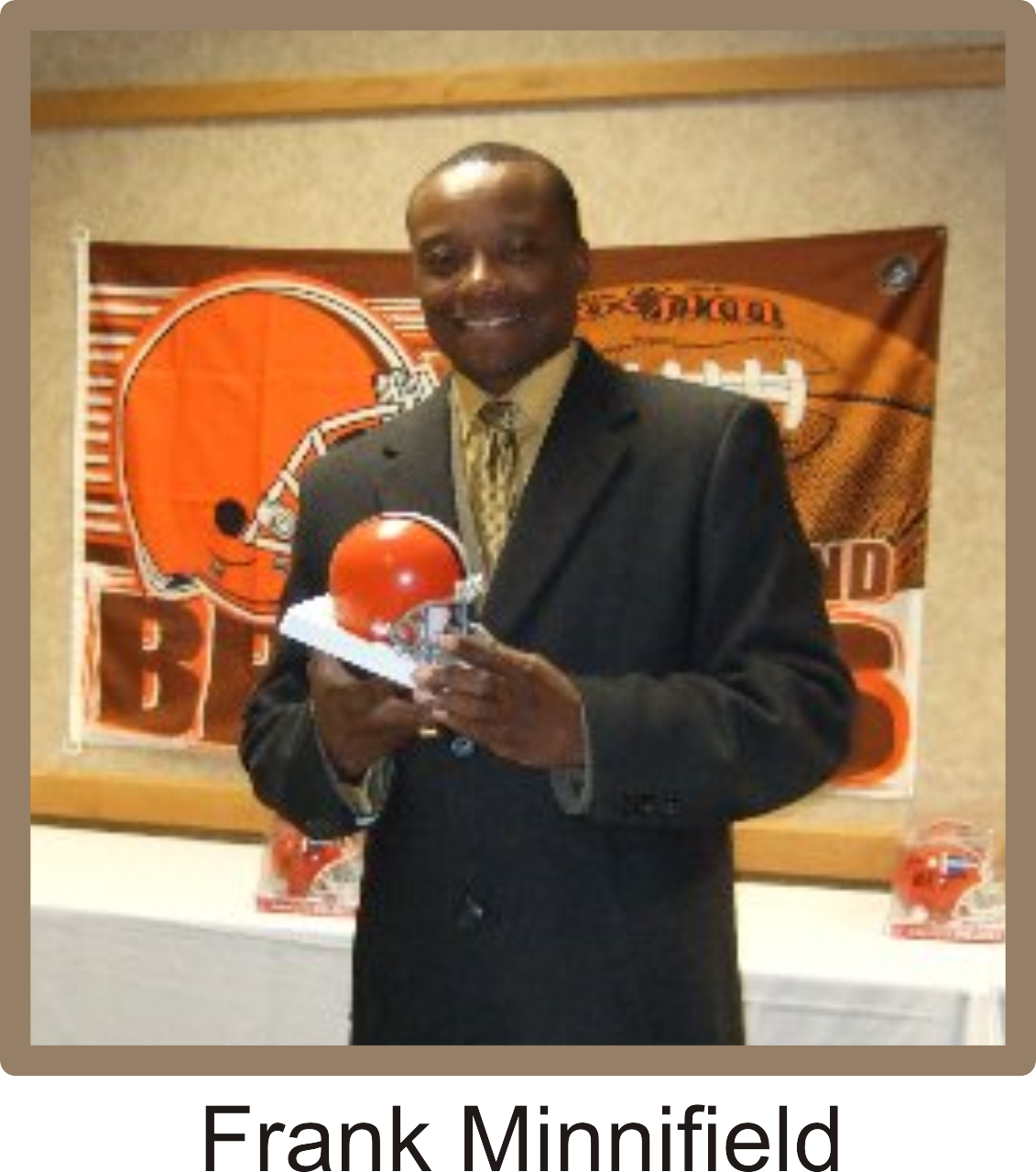
Former Cleveland cornerback Frank Minnifield says 1987 work stoppage divided Browns

The most recent time there was a work stoppage in the NFL was the players' strike in 1987. They walked out to force owners to give them free agency after their contracts ran out.

Ultimately, the players got what they wanted. But to get there, they had to endure the immensely divisive strike, which was broken by the owners' use of replacement "scab" players; four years of partial free agency and other management-friendly rules imposed by owners; decertification of the players union; and finally a huge win in federal court.
By the time a new collective bargaining agreement was reached in 1993, featuring unrestricted free agency for players and a salary cap for owners, many of the players who walked picket lines in 1987 were too old to take advantage of the new system.
Browns cornerback Frank Minnifield was one of them. Minnifield joined the Browns in 1984 and retired after his last season with them in 1992. A successful businessman in his hometown of Lexington, Ky., Minnifield views the current work stoppage with interest. His son, Chase, a starting cornerback at the University of Virginia, will be a draftable player in 2012.
"It's a shame," Frank Minnifield said of the labor dispute. "It happens probably to every generation. I guess it's just part of the evil that's associated with the NFL. You know, money is the root of all evil."
This time, the owners have precipitated the stoppage. They've locked out players and want a deal that is less favorable to the players.
"The owners have such a huge advantage on the players," Minnifield said. "I'm sure we're all amazed [the players] have been able to negotiate to the position where the owners feel they're at a disadvantage. But I don't believe the owners are going to lose that much money."
Minnifield, naturally, sides with the players in this newest scuffle. He said they deserve all the money they can make in their short careers.
"There's just too many kids who get hurt to the point where their life is affected the rest of their lives," he said. "I saw a statistic . . . it was mind-blowing, about how many kids in college are maimed because of football. Then you're talking about a person in the owner's box, just taking a financial risk. That's a different risk than a physical risk."
Minnifield is 51. He played two years in the United States Football League and came to the Browns after surgery to fix a busted a knee. The rest of his injuries in his nine-year NFL career, including a lacerated kidney, were treated without surgery.
"I think anybody that was on the football field trying to win has a [health] problem," he said. "I'm not in no hospital, but I know I played 11 years of pro football. I like playing golf. There are many times I have to say, 'I can't play today,' with something hurting. There's many of those days. That goes on with all of us.
"Some of these guys get through it unscathed, without paying a real heavy toll with their health. But I would say the majority, over 50 percent, when they get to my age will be experiencing some problems they don't even realize. And they're going to need all the money they have to make it to 70. It takes a lot of money to make it to 70."
When Minnifield thinks back to the 1987 strike, the memories are not pleasant. The players walked out after the second game. The third game of the season was canceled. By the fourth week, owners had rounded up whole new teams of "replacement players" -- former college or pro players who had gone on to their life's work as truck drivers, teachers and the like.
Stressed for money, the regulars slinked back late in the week after the second "scab" game -- only to be turned away until the replacements were given a third game. Divide and conquer was a successful strategy for the owners.
The strike tore apart the Browns, Minnifield said.
"It got real ugly," he said. "I think those days are still kind of a little messy for all of us because of how we were all divided. I really believe that it really messed up the chemistry of our team from that point on."
Surprisingly, Minnifield did not begrudge the replacement players from taking his job temporarily. Much stronger emotions were spent on the regular players who broke ranks and crossed picket lines. Eight Browns did that for the third replacement game, including team leaders such as Gary Danielson and Ozzie Newsome.
"It was kind of hard dealing with the fact some guys went back, some didn't, and some guys were financially better off because they went back [versus] the guys who stayed together," Minnifield said. "I think that was tough. We didn't talk about it because everybody would get mad. But I think it affected us for the rest of our careers together.
"We didn't want anybody to go back. We wanted to stay together and whatever consequences there were we wanted to face them as a team. If we were going to have to fight harder because we were behind and lost those three games, then so be it. I don't think anybody was going to accept any reason for crossing the line.
"We had a special relationship. Our whole team was special. We'd go over each other's house. We actually liked each other. There aren't too many [teams] that hung out like we did. It was common to go over somebody's house each week and just eat together. Thanksgiving was unbelievable. After that strike, we didn't do it again. Most of that stuff just stopped. There was a whole lot of guys who were upset that didn't talk about it. We went on with our business. But our relationship was never the same."
The Browns were hurt more than most teams by the disruption. Coming off the AFC Championship Game loss to John Elway and "The Drive," 1987 was to be their year. The strike wiped out Game 3 of the '87 schedule. It happened to be Elway's regular-season return to Cleveland.
Had the game been played and the Browns won, they would have finished with a better record than Denver and earned home-field advantage in the '87 season AFC Championship. Instead, they had to play in Denver. Elway again prevailed in the loss remembered by "The Fumble."
"We would have beat Denver in Cleveland because we were a better team," Minnifield said. "They wouldn't have beat us two years in a row. That was our best team. We were all young kids. We were probably as good as football players in '87 as we were in our whole career." 

Reported by Tony Grossi, The Plain Dealer

Friday, March 18, 2011

We Have Been Officially Approved!!!

We have been notified by the Cleveland Browns that we are an officially sanctioned chapter of the Browns Backers Worldwide organization.  There will be more news to come!
Chapter Number 581


Browns WR Rod Windsor heads to Arena Football League

James Walker of ESPN reports that a Browns WR from the practice squad will ink with the AFL team in Arizona.
Due to the lockout, a Cleveland Browns receiver has bolted to the Arena Football League. Rod Windsor, who spent time on Cleveland’s practice squad in 2010, signed this week with the Arizona Rattlers.
Windsor remains under contract with the Browns, but with no collective bargaining agreement in place players are free to sign with other leagues. Other more high-profile players in the AFC North such as Cincinnati Bengals receiver Chad Ochocinco and Baltimore Ravens safety Tom Zbikowski have opted for soccer and boxing, respectively.
Before joining the Browns, Windsor played with the Rio Grande Valley Dorados (af2) in 2009. Windsor hauled in 184 balls for 2,364 yards and 59 touchdowns with the Dorados. Windsor was awarded Offensive Player of the Year and Rookie of the Year. In 2010, Windsor joined the Arizona Rattlers (AFL) and hauled in 193 balls for 2,372 yards and 47 touchdowns. His 2010 performance earned him AFL Rookie of the Year honors.

Thursday, March 17, 2011

Are the Browns Totally Committed to McCoy as the 2011 Starting QB?


As NFL.com points out, seems like the Browns are looking at some of the top QB’s on this years NFL Draft, meaning that the team may not be as committed to Colt McCoy as some think they are. Here’s what NFL.com has to say about the team shifting their focus at the QB position elsewhere.
The Browns represent one of the most intriguing teams in the top 10 of the draft due to the thinking they could go in several directions with the No. 6 overall pick. Team president Mike Holmgren isn’t tipping their hand, either, telling reporters Monday the team hasn’t ruled out taking a quarterback with their first pick and is “looking hard” at Auburn QB Cam Newton. So while Holmgren refers to Colt McCoy as having “huge upside,” he also leaves us with gems like this when asked about having to perform due diligence with other quarterbacks: ”It’s kind of interesting, isn’t it? We’ll see. I would say, don’t discount anything. …” Which all leads to one big question: Are the Browns committed to McCoy as the quarterback of the future?
“I don’t know how they can ultimately be sold on McCoy,” says resident GM and analyst Michael Lombardi. “His injuries down the stretch, his body is not the biggest or strongest, and can he endure 16 games? These are all questions that have to be answered by the new staff (who) have to be comfortable with the answers and see if they can move forward before they do anything else — draft or trade.”